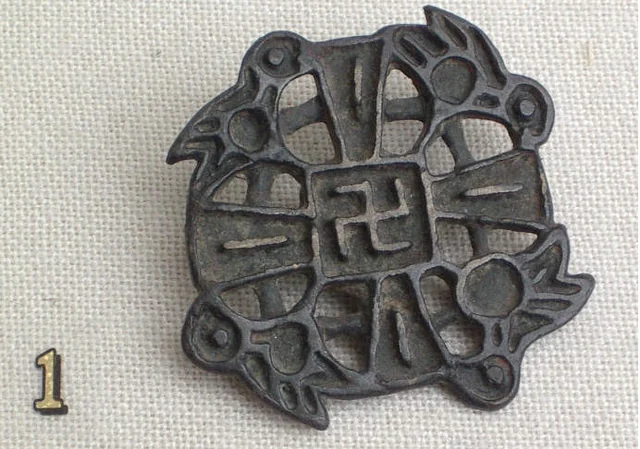
In the 1920s, a large number of metal cross seals was discovered in Baotou, inner Mongolia of China. These seals are regarded as a significant milestone in the history of Chinese Christianity. More importantly, these seals also significantly reflected people's understanding and attitudes towards religion in the Yuan dynasty and provided us an insight into the changing intellectual landscape of ancient China. This essay will explore one of these seals which is collected by Royal Ontario Museum and explain the meanings of symbols in this seal. What information can the use of swastika tell us in this seal? To what extent did Nestorianism impacted by Buddhism? And based on all the information we get, in what way these seals reflect people's attitude towards religion.
The mix of symbols from different cultural origins is the most eye-catching feature of the seal. Within this one small seal, we can find the Greek style cross from Christianity and the Buddhism originated swastika. And the character of the swastika is the most interesting element of the seal. Despite the swastika character appearing in China much earlier than Buddhism, scholars argued that after Tang dynasty, in later generations, the official formation of the Chinese character ‘卍’ was obviously influenced by Buddhism. So we could say this symbol carries the Buddhist meaning of ‘the source of all blessings’ and thus the seal becomes a reflection of the merge of Buddhism and Nestorianism symbols.
The discovery of a large number of seals reveals the revival of Nestorianism in the Yuan Dynasty. And the revival of Nestorianism was very largely impacted by the entrance of Mongolians and Semu people. At that time there were many Mongols who are Christians, for many of the sons of the Mongol Kings and queens have been baptised and confess Christ. Their entry into China proper has enabled the rapid development of Nestorianism. Coupled with the active trade and the open policies in religion, Nestorianism achieved sufficient development during the Yuan dynasty./p>
Beside the factor of external communication, the adoption of localization is also a key factor for Nestorianism to successfully integrated into Chinese society. And the merge of Buddhism elements into the Nestorian seal is the most obvious example of the localization in China. The reason why this element appears is because of the extreme popularity of Buddhism among Chinese society. Since Buddhism has entered and developed in China over thousands years, people’s understanding of religion was very largely shaped by Buddhism, many Buddhist patterns and phrases with positive meanings were used in non-religious situations.
From Emperor to peasants, ancient Chinese people had a very high acceptance of Buddhism rather than all the other religions. With the examples Emperor Wu of Liang, Wu Zetian, and Kublai Khan all practised and promoted Buddhism during their time. These spiritual traditions have saturated the Chinese language, cultural customs, and social life, so that, consciously or unconsciously, every Chinese person growing up in a Chinese environment has inherited some of them. Therefore, Buddhism occupies a very important position in Chinese society. And people’s understanding of religion was very largely shaped by Buddhism, many Buddhist patterns and phrases with positive meanings were used in non-religious situations.
Why, then, did ancient Chinese people attribute a positive meaning to the Nestorian seal that originally did not belong to it? A plausible explanation is people's utilitarian pursuit of religion. People’s attitudes toward religions back to the time required religion to be useful. With the example of Buddhism and Taoism, these two widespread religions among both ordinary Chinese and scholar-officials (Shidafu) were seen as a tool to help them solve problems and achieve goals.
Especially in the time after the Song dynasty, the rapid development of thoughts like Neo-Confucianism has changed people’s mind towards religion. The utilitarian function of a religion was even more emphasised, the role of three teachings (Taoism, Confucianism, and Buddhism) has become more about a tool that helps the emperor to rule their people. A series of intellectual and political reform has made the power of the country become more centralised, and the emperor owns authority of directing each religion. An example is Zanning, who is a Buddhist leader chosen by Song emperor, he adopted an amiable stance on the Three Teaching and assigned the role of directing the Three Teachings to the emperor. Under such a background, the role religion played in the society has been far away from 'religion' itself, it carries the command from the imperial court.
Starting from the Song dynasty, emperors of all generations were pursuing the centralization of power and the total control of the country. The idea of “Merging Three Teaching” has been engraving into scholar-official’s minds. Both Zongmi and Yanshou have in common that they both consider Buddhism to be the origin and goal of the Three Teachings. This kind of idea makes people believe that there is no other origin [than Buddhism] if the dharma realm is used to include them, people think all the religions were declaring the same thing and shared the same origin. This kind of idea also impacted the ordinary people like peasants and merchants, they wished a religion could bring them luck and wealth. Thus, for Nestorianism, such an ideology from top-down made the Sinicization become something that had to be done.
Under the different religion atmosphere with Syria, Nestorianism has to adapt and integrate Chinese elements, aligning itself with the local religious landscape. It is a process by which the non-Chinese, through the accumulation of knowledge of the Chinese tradition, accommodated their cultural and religious heritage to the Chinese situation in order to be able to function in Chinese society. This merging of cultures not only helps in overcoming official resistance but also serves as a powerful magnet to draw a large number of followers.
In conclusion, the discovery of these seals offers a presented us the image of cultural fusion and shows the religious attitudes of ancient China. The localised development of Nestorianism, in the case that it merges Buddhism elements, has helped to gain the chance to get a widespread across China. Although the popularity was relatively small compared to Taoism and Buddhism in that time, being a late entrant in the Chinese religious landscape, this is an achievement truly worth being proud of.